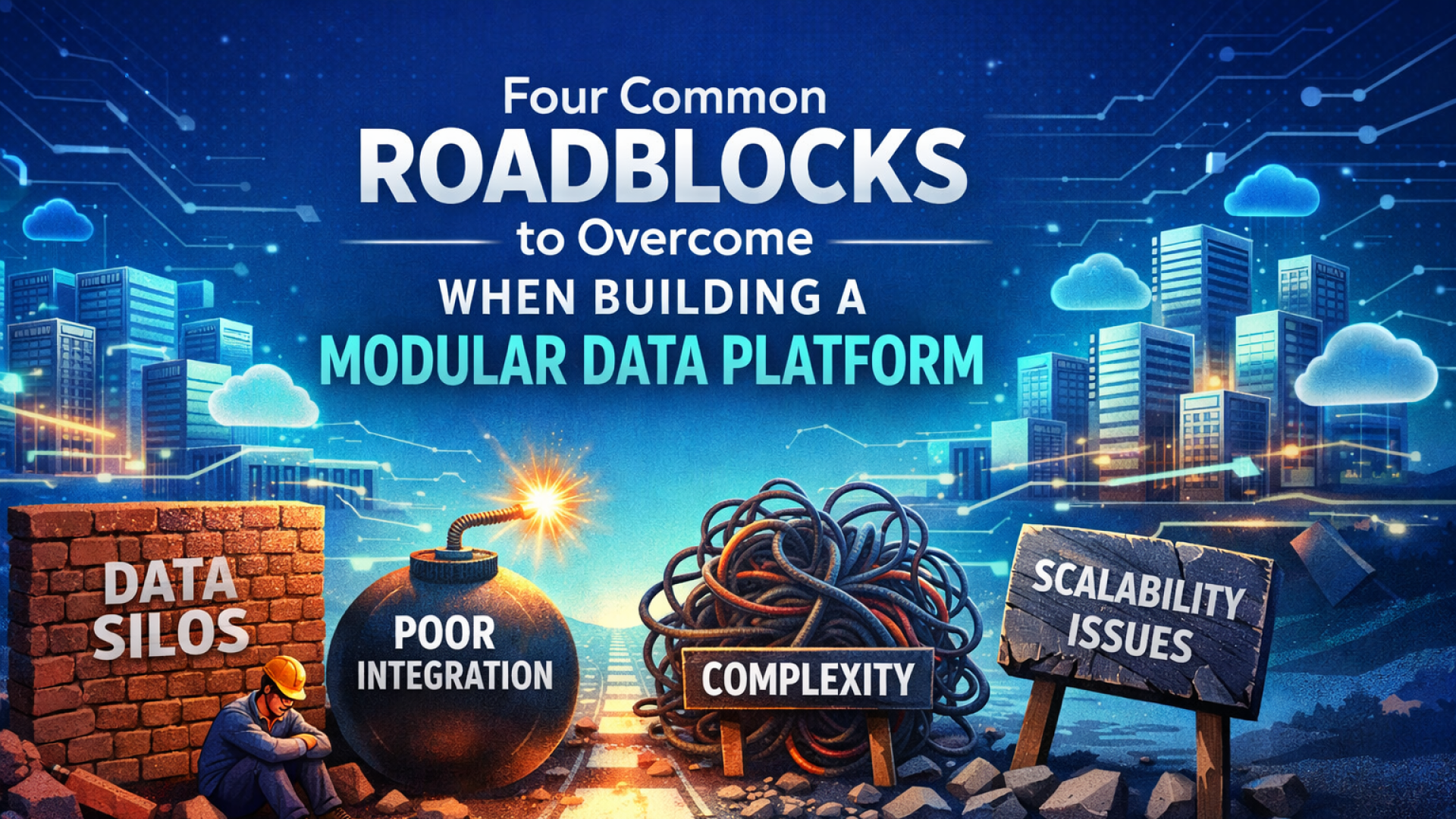
Four Common Roadblocks to Overcome when Building a Modular Data Platform

February 9, 2026
When selecting a data engineering partner, speed and lower cost may seem like the right choice, but what really counts is long-term performance. Speed and lower cost may seem like the right choice at the onset, but what counts is long-term performance. In order to avoid data platform pitfalls, it’s important to explore common challenges organizations face when building them. Given our expertise, Augment also has solutions for overcoming them.
From years of experience building long-term relationships with clients, staying around long enough to see data platforms succeed or fail, and being called in to fix broken ones, we’ve learned what commonly goes wrong, why it happens, and how you can avoid it. There are four major hurdles:
#1
Takes a long time to build
Why does it take so long to build? It takes several months to launch a data platform, and that is where most organizations feel stuck. One of the major bottlenecks to rapidly building data platforms is the lack of centralized data. It may take months to years to build a new use case. It feels like starting from scratch each time.
#2
Data Silos across organizations can be challenging
Sharing data across organizations is no easy task. Have you heard of “data silos”? Siloed data can’t speak to each other. The problem with siloed data spread across multiple data warehouses is further attributed to the time it takes to incorporate data into a centralized data platform.
#3
Building data platforms can be expensive
A common issue clients bring to us is that data platform costs increase exponentially as concurrent usage grows, forcing companies to scale back on their infrastructure to contain costs.
#4
Slow Performance of Data Platforms
The performance of data platforms is affected by a multitude of factors. Insufficient memory and full table scans can slow down performance.
None of these roadblocks is a standalone issue; they are interrelated. Addressing one of these effectively can help us resolve the others. The first one is critical, but all are imperative. For example, if the build time can be shortened, in turn, it resolves the data silo problem.
Is it possible to rapidly build a modular platform?
Yes. Our “Data Platform Accelerator” is designed to work on the philosophy of “Built to Last”, which is our way of saying it’s scalable and future-proof. We have developed a set of standardized best practices and an architecture that aligns with those best practices. With our standardized playbook, we can start development right from the very first hour, thereby breaking the first barrier, the time taken for development.
Also, we have seen that data testing times can be significantly brought down by breaking down the pipeline into discrete steps that can each be run, and the output of which is a permanent table that acts as the input for the next table. This way, issues with the data can be tracked down.
Rather than clients asking how we can build something for their use cases, we evaluate how their use cases can align with the standard model, and analyse the need for any adjustments to that model to fulfill this particular use case. This helps cut down on time and therefore, cost.
Ready to build your own Modular Data Platform?
Partner with us to explore.
Related posts

Why Digital Prototypes Save Companies Thousands Before Development Ever Begins
One of the biggest misconceptions in software development is that writing code is the first step. It shouldn’t be. The most successful digital products often begin with something much simpler: A prototype. Before developers build databases, APIs, or cloud infrastructure, product teams should answer a more important question: Are we building the right product? Digital …


Why the Best Digital Products Are Built Through Long-Term Partnerships, Not One-Time Projects
Many organizations think of software development as a project. Build it. Launch it. Move on. But the most successful digital products don’t follow that path. They evolve. Customer expectations change. Markets shift. Technology advances. Artificial intelligence creates new opportunities. Products that remain successful continue improving long after launch. Launch Is Just the Beginning The …

The Hidden Cost of Fragmented Healthcare Data: Why Disconnected Systems Are Slowing Healthcare Organizations Down
Healthcare organizations have more data than ever before. Every patient interaction, insurance claim, laboratory result, appointment, and financial transaction generates information that can improve decision-making. So why do so many healthcare leaders still struggle to answer seemingly simple questions? Which payers are driving the highest denial rates? How are quality initiatives affecting reimbursement? Where are …