
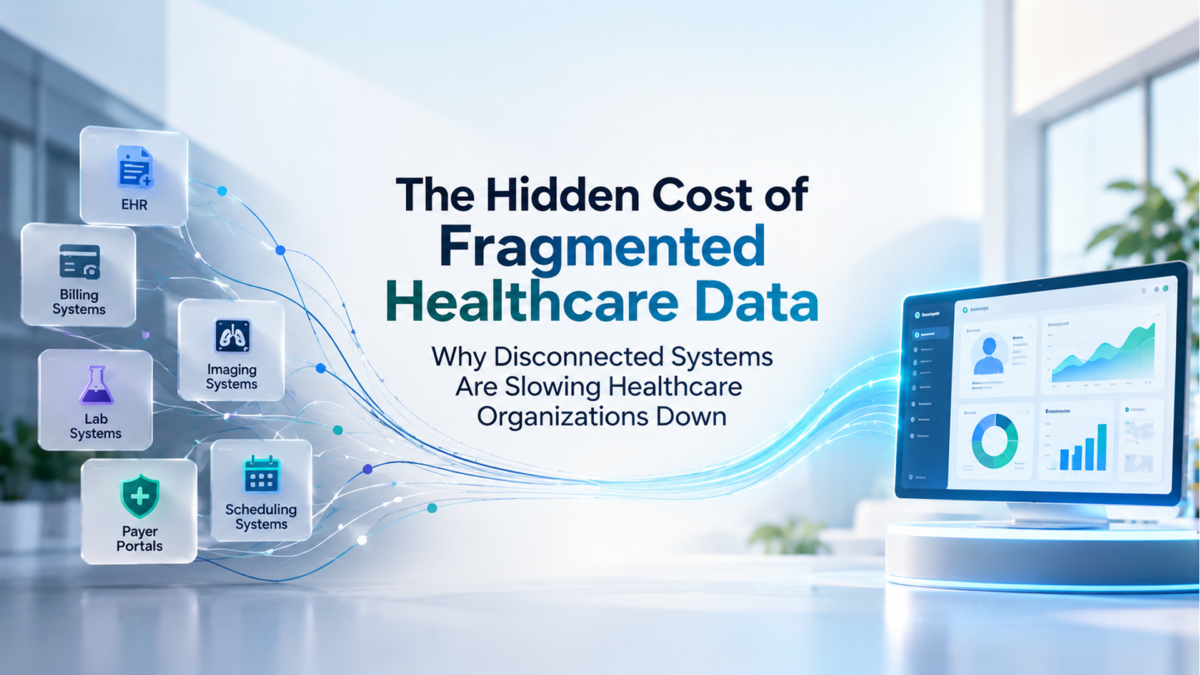
The Hidden Cost of Fragmented Healthcare Data: Why Disconnected Systems Are Slowing Healthcare Organizations Down

Healthcare organizations have more data than ever before. Every patient interaction, insurance claim, laboratory result, appointment, and financial transaction generates information that can improve decision-making.
So why do so many healthcare leaders still struggle to answer seemingly simple questions?
- Which payers are driving the highest denial rates?
- How are quality initiatives affecting reimbursement?
- Where are operational bottlenecks slowing patient care?
- Which service lines are performing best financially?
The answers usually exist—but they’re scattered across multiple systems.
For many organizations, the biggest challenge isn’t collecting data. It’s connecting it.
Fragmented data has become one of healthcare’s most expensive operational problems, quietly impacting financial performance, employee productivity, compliance, and the ability to adopt emerging technologies like artificial intelligence.
Healthcare Runs on Data—But the Data Rarely Lives in One Place
Over the past two decades, healthcare organizations have invested heavily in technology. Electronic health records, billing systems, scheduling platforms, payer portals, customer relationship management tools, laboratory information systems, imaging software, and specialty applications have all helped digitize healthcare operations.
Each system serves an important purpose.
The challenge is that they often operate independently.
As organizations grow, the number of disconnected systems tends to increase. Physician practice acquisitions, hospital mergers, new service lines, and evolving regulatory requirements introduce additional applications and databases into an already complex environment.
The result is a technology ecosystem where valuable information exists everywhere—but rarely together.
The Four Hidden Costs of Fragmented Data
The effects of disconnected systems aren’t always obvious. While organizations often recognize reporting challenges, the broader business impact is easy to underestimate.
1. Productivity Is Lost to Manual Reporting
Analysts and operational teams spend countless hours exporting reports, cleaning spreadsheets, validating information, and reconciling conflicting numbers.
Instead of analyzing trends or identifying opportunities for improvement, highly skilled employees become data collectors.
This manual work not only consumes valuable time but also increases the likelihood of human error.
Imagine reclaiming those hours and redirecting them toward strategic initiatives instead of repetitive reporting tasks.
2. Decision-Making Slows Down
Healthcare leaders need timely information to make informed decisions.
When data is fragmented, every executive question becomes a reporting project.
A request to review denial rates by payer, compare performance across facilities, or evaluate quality metrics may require multiple departments to gather information from different systems before a complete picture emerges.
By the time reports are delivered, the information may already be outdated.
Organizations that can access trusted data quickly are better positioned to respond to operational challenges, financial pressures, and changing patient needs.
3. Revenue Opportunities Are Missed
Revenue cycle performance depends on visibility.
Without connected data, organizations may struggle to identify:
- Emerging denial trends
- High-performing or underperforming payers
- Delays in claims processing
- Coding inconsistencies
- Opportunities to reduce days in accounts receivable
- Revenue leakage across service lines
Small inefficiencies repeated across thousands of claims can add up to significant financial losses over time.
When revenue cycle teams have access to integrated data, they can identify issues earlier and prioritize improvements that have the greatest financial impact.
4. AI and Advanced Analytics Become More Difficult
Artificial intelligence has tremendous potential in healthcare, but AI cannot overcome fragmented information on its own.
Machine learning models, predictive analytics, and generative AI all depend on accurate, consistent, and accessible data.
Organizations often invest in AI tools only to discover that the majority of the project involves preparing and cleaning data rather than building intelligent applications.
The lesson is simple:
Data modernization isn’t separate from AI strategy—it is AI strategy.
Why More Dashboards Aren’t the Answer
When reporting becomes difficult, organizations often respond by creating additional dashboards.
Dashboards can improve visibility, but only if they’re built on reliable data.
If each dashboard pulls information from different systems with different definitions, leaders may receive multiple reports that tell different stories.
This creates confusion rather than confidence.
The real solution isn’t another dashboard.
It’s establishing a trusted data foundation that ensures everyone is working from the same information.
What a Modern Healthcare Data Platform Looks Like
Rather than replacing existing technology, modern healthcare data platforms connect it.
Data from electronic health records, billing applications, payer systems, laboratory platforms, operational software, and third-party tools is brought together into a centralized environment.
Once integrated, organizations can:
- Create a single source of truth for reporting
- Deliver real-time executive dashboards
- Automate recurring reports
- Monitor operational and financial KPIs
- Improve collaboration across departments
- Support AI and advanced analytics initiatives
- Scale data capabilities as the organization grows
This approach allows healthcare organizations to maximize the value of the technology investments they’ve already made.
From Reactive Reporting to Proactive Decision-Making
One of the biggest benefits of unified data is the shift from reactive to proactive operations.
Instead of waiting until the end of the month to identify trends, organizations can monitor performance continuously.
Revenue cycle teams can detect denial patterns earlier.
Operational leaders can identify workflow bottlenecks before they affect patient experience.
Executives can access current performance metrics without waiting for manually prepared reports.
This enables faster decisions backed by trusted information.
Building a Foundation for the Future
Healthcare organizations face increasing pressure to improve outcomes while controlling costs.
Success will depend not only on adopting new technologies but also on making better use of existing data.
Modern healthcare data platforms provide the foundation for:
- Better operational visibility
- More efficient reporting
- Improved financial performance
- Stronger regulatory compliance
- AI readiness
- Scalable analytics
Organizations that invest in connected, well-governed data today will be better prepared for tomorrow’s challenges and opportunities.
Key Takeaways
- Fragmented data affects every part of a healthcare organization—not just IT.
- Manual reporting reduces productivity and delays decision-making.
- Connected data improves revenue cycle visibility and operational performance.
- Dashboards are only as valuable as the data behind them.
- A modern healthcare data platform creates the foundation for analytics, automation, and AI.
Frequently Asked Questions
What causes fragmented healthcare data?
Fragmentation often results from multiple EHRs, billing systems, payer platforms, legacy applications, mergers and acquisitions, and specialty software that were implemented over time without a unified data strategy.
Why is fragmented data a financial problem?
Disconnected data makes it more difficult to identify denial trends, monitor reimbursement performance, reduce manual work, and uncover opportunities to improve revenue cycle efficiency.
Does fixing fragmented data require replacing existing systems?
No. Most organizations can modernize their data by integrating their existing systems into a centralized platform rather than replacing core applications.
How does data integration support AI?
AI models require high-quality, connected, and well-governed data. Integrating data across healthcare systems creates the foundation needed for reliable AI and advanced analytics.
Turn Healthcare Data Into a Strategic Advantage
Healthcare organizations already have the data they need to make smarter decisions—the challenge is bringing it together.
At Augment, we help healthcare organizations integrate fragmented data, modernize analytics, and build scalable data platforms that improve reporting, strengthen revenue cycle performance, and prepare organizations for the future of AI.
Whether your goal is reducing manual reporting, improving operational visibility, or creating a trusted source of truth, a modern healthcare data strategy can help you move faster with greater confidence.
Ready to unlock the full value of your healthcare data? Contact Augment to start the conversation.